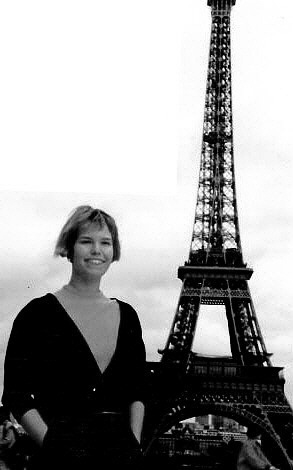
I was a late bloomer, no doubt about it. Blanketed in illness, abuse, and the weight that protected me from it, I cultivated the skill of making myself invisible, somewhat unsuccessfully. I was tormented through most of high school, until one day my mom pushed my doctor to send me to a specialist for a condition that showed no signs of improvement after twelve years of treatment. Lo and behold, the specialist determined that I had never had the condition to begin with, and thus began the long tapering of the medication that had treated this non-condition. Following that, I lost close to a hundred pounds. I was a new person, and I had no idea what to do with that.
Even in my sickness and sadness, I had always romanticized a life where I was loved and had friends. I had pen pals instead, and honed my writing skills, in English, French, and as much as I could, in German. I imagined the life I wanted, which to me was clearly not in the Midwest, and probably not even in the United States. Post-weight-loss, however, I relinquished my international fantasy for some time, looking instead to separate my new self in every way from my old self. I had been quite shy–not introverted, though, as I was a miserable fat girl who leaped on any opportunity to leave my house. I had always done well in school as fat Julie, while avoiding certain situations and hallways and classes and boys with the initials JB–tormentors whom I had to pass to get to my locker in the JC section. As a new thin Julie, I intentionally failed a calculus exam because I feared so much being that nerdy book-smart fat person again.
The few friends I had as fat Julie seemed completely different when I became thin Julie. In fact, they were nice girls, but it was clear from the start that to them, I was little more than a friend of convenience during school lunch. It was incredibly rare that they invited me along with them anywhere outside of school in my fat days, but they talked to me and were not mean, and I thought that was about as much as I could have. I thought it was all because of my unfortunate appearance, and it probably was. Still, it is hard to manage transformation in oneself or in people we know.
Life seemed lonelier to me when I was thin, to my utter dismay, but it was different. When I was thin, those JB boys started talking to me. One day, one of them turned back to tell me there was a party, and I should come… I wanted to, desperately. A new girl who never knew fat Julie watched me as I flushed and wondered about this. She and I became friends, and she warned me about what these boys wanted. It was a shock–really? I had no idea.
I just wanted to be like other people. I wanted to go to prom. I asked five boys to go with me, and they all said no. Prom night was–in some ways, still is–a pit in my stomach. I felt sick that night, and incredibly sad. Wandering the halls of the senior party that my mom had worked so hard to organize with other parents, I ended up walking home alone in the wee hours. I danced with one of the JB guys that night, and he signed my yearbook saying that he hoped all my dreams came true, someday.
My first date request came a month or two later, from the English teacher in the summer school. Earnest as I was, I worked for five years in the high school office during the summers, and it was a great job. One of my duties was collecting the summer school attendance, and this teacher was there. He asked me out. He told me that I was beautiful… now. I was so flustered I had no idea how to answer. The next day, he told me that he never should have asked me, and asked me also never to tell anyone at the high school. I saw him a couple of years later walking in the town where I was working at the time. He had become a lawyer. I had many other odd acknowledgements that I could be considered pretty. A random neighbor saw me riding my bike, and asked if his real estate company could sponsor me in the town beauty contest. My parents were appalled. I never ran for Miss Webster. I wish I had, I think, but the decision was made for me. That was that. I was so done with my life at home that my bags for college were packed months before I had to leave.
Of course, I changed in more ways than one when I was no longer sick and fat. After my dramatic glow-up, I became determined to put myself out there and talk to people I had previously avoided. The friend of my mom in the grocery store? I ran up and chatted happily. Total and complete strangers? Anyone who smiled at me would get a conversation, and it turned my world around. Once I finished high school and was no longer surrounded by that community, new friends seemed to pop up, and I was happy. I could avoid the torment of an alcoholic father–torment because I loved him despite his beer-fueled anger and cruelty–by riding my bike as hard and fast as I could. I kept pushing myself, and went off to college, avoided many of the more dangerous possibilities in a frat party, for example, simply because I was too scared to do anything too wild.
By halfway through my freshman year of college, I ended up dating a perfectly nice guy. I had returned to my passion for languages and writing then, as I realized that I could keep some of my qualities and not become the monster I imagined myself to be as fat Julie. I even thought about settling down with my perfectly nice boyfriend after we had been dating for another year.
Then, my dad died. It was a long time coming, but lung cancer took him a year after he was diagnosed. I quit school after my second year at Mizzou, and in that new fearlessness and determination I had developed, I decided to go into translation. It was unrealistic, but I was oblivious and optimistic, and went door to door with a resume–and somehow, I did end up working in a translation company! My perfectly good boyfriend was a reporter in love with small-town stories, while I wanted to see the world. I started to feel all that I could do, all that I wanted, and broke up with him. I fell in love, deeply, with a Uruguayan poet. I saved money and returned to college–this time a good school in my home city. I spent all my savings on school, and then, broke, went to France for my senior year–really, the only affordable way for me to finish my degree with the award I received from the Alliance Française and a generous grant of some sort from the French department. But it was France! And I still got the degree from my rather prestigious institution.
I had left my translation agency job and returned to school, so money was always an issue, and I took all sorts of odd jobs to make ends meet in addition to my work-study job in the language department. One of these jobs was babysitting my undergraduate advisor’s two adorable children while he taught an afternoon seminar. I picked them up from school and walked them home until my professor or his wife came home. It was all lovely, and I felt in the mix of everything I loved. I babysat during some parties, and thought I had become fairly good friends with my professor’s whole family. I had worked so hard, and accomplished so much despite the odds in my young life, and it was all working out so well for me!
When I returned from France, I had graduated and was trying to figure out what to do next. The whole experience at the university where I had transferred after the translation company had made me slightly cynical. Yes, it was wonderful in so many ways, but I was in a small group of local kids who scrapped by–which was great, but not easy when I was separated from them. I was happy enough struggling on a low salary and finding my way until I was surrounded by kids who had never worked and who had rich families and opportunities I couldn’t quite figure out how to reach. I worked hard, and still was always broke, but I remained optimistic.
After I graduated, I had many, many job interviews, nearly landing opportunities, but never quite finding anything. I had all those secretarial skills from the high school job, and I worked temp, a lot. I scraped by. Finally, the head of my department at the university asked me to come in for a chat. He more or less invited me to graduate school, and I decided that if I did not get a job at the refugee resettlement organization, where I was a finalist against one other person. I would take him up on the offer.
I didn’t get that job. I enrolled in the French graduate program.
I heard around that time from my undergraduate advisor–not about babysitting, but about meeting for coffee with him and his wife. I was thrilled to chat about life in France with them, to catch up. We set a time. Last minute, the professor changed the place to a dive bar not far from my house. He and his wife always talked about going in for that sort of adventure, so I wasn’t too surprised. I headed out to meet them on that December evening.
When I arrived, my professor’s old Chevy was parked far back in the dark lot. I also had an old Chevy, and both cars stood out even back then. The door to his car opened, and the professor motioned me over. His wife couldn’t make it. It was cold, and he told me to get in the car to get warm. I did, and noticed the lighted joint he was holding. He offered it to me, but I have always hated marijuana, not on moral grounds, but just because it makes me feel stupid, and I hate the smell. The whole situation annoyed me a little, and my professor told me all about his semester, the first one after he had achieved the difficult process of gaining tenure. His graduate seminar had bombed, he told me. I was a little surprised to hear that from this normally jovial man. But I sympathized, as one does.
All of a sudden, my professor, my former advisor, grabbed my hand and put it down his pants.
What?! What about his wife, and his kids?! I was so shocked I just pulled back my hand and sat there. He wanted to see Christmas lights, and I didn’t say a word. He drove around for a little while, tried to hug me. We came back, and I was going to leave, but he convinced me to go get a beer, which I ordered, but didn’t drink. I left, and went home, and didn’t tell anyone.
I tried to avoid the professor after that. He was in a bad place. No one would believe me.
As a late newcomer to the master’s program, I had few choices for classes, and was forced to take the professor’s class in rhetoric. The class I wanted to take with the famous author was overfilled, and the graduate advisor told me I should be happy in the class with my professor, since I knew him fairly well. To be fair, I loved the subject of rhetoric. Still, sitting through those seminars was torture. It was a tiny class with a brilliant undergraduate and a few comparative literature, philosophy, psychology students. I wrote some papers that went over pretty well to my colleagues. B+ to my teacher, which translates roughly to “eh” in graduate school.
I muddled through and found what I thought was a great topic for my final paper. Other classes were good, and I enjoyed the topic.
B+
A week or so after I handed it in, my professor called me and told me that my paper was fantastic, and that I should present it at a conference. He knew of the perfect chance to do this, a conference on film and literature bla bla bla, and he offered to work with me on the paper to prepare it for consideration. He said it was exactly what they wanted to see.
In spite of that moment in the car, I admit that I was excited. Back then, master’s students never tended to present papers, and here I was, first semester, reading my fantastic essay. I was supposed to go to my professor’s library carrel to work with him. I hesitated. Never went.
In the midst of all this, I was falling in love with a guy who was perceptive enough to read my anxiety. I told him everything that had happened in the car. My boyfriend was kind, and urged me to get away from that professor. It was a relief to talk about it. The professor called me, and said he would just not go to the conference, either, if I wasn’t going. I had no idea that he had intended from the start to accompany me to the conference. What a shock to realize that he had not swept the unfortunate event in the car under the rug, as I had tried to do. His intentions were not to boost my career, but rather, to get me alone in another city.
Fast forward another year, I was getting ready for my master’s exam. I had managed to avoid my former advisor entirely for the last two semesters, and was happily hired as an assistant editor for another professor. I had several side tutoring jobs, had taught summer school, and was invited enthusiastically to stay for my doctorate. I had all I wanted. The school allowed us to name our own exam committee, but there was a last-minute change. My undergraduate advisor would participate in my exam, despite my wishes.
I studied. I had worked hard. The day of the exam, I felt prepared. The questions were to be based on our classes. I arrived with my blue book ready to write.
I looked at my questions. I began to sob.
One of the three questions–the one from my now-unfriendly professor–was beyond my comprehension. What was it? What was he asking? In my panic, I tried to remember– there was once, during a break, another student was talking to him about that particular topic, but knew only a little. Others from other fields were chatting about it–I did pick up that much–but it was not a literature question, and I certainly could not recall enough for me to write pages with references to works I had read. I calmed enough to answer the other two questions, not well, as I was shaking throughout. I left the exam after about an hour.
I happened to run into the Uruguayan poet quite by chance right after the exam. It had been a couple of years since our dramatic breakup, but there he was, with his daughter. How odd. I met his happy little girl with ice cream dripping down her chin, nearly surreal, then went home and went to bed.
The written exam was only part one of the test; part two was the oral defense. I studied the topic of the unanswerable question over and over, consulted with a student in the particular subject of that question, and braced myself.
The oral exam came and went with much less drama than I had expected. The department chair commented on the oddness of that unanswerable question, but no one asked me a single question about it. I covered everything else with only a little nervousness, and assumed that the whole test was fruitless, anyway. Surely I didn’t pass.
Shortly after the oral exam, the graduate advisor (not the undergraduate advisor, but the professor who had invited me to consider doctoral studies) brought me into his office. He was surprised and ashamed of my performance. I waited for the announcement that I had failed.
I passed, but was no longer invited to stay for my doctorate, of course.
A favorite professor who was unavailable for my exam committee told me that I had been “vulnerable,” and apologized. Other teachers shook their heads and told me that the whole thing was a shame. I was distraught, and never went back to the department, ever again. I still have never returned, and have not been on campus there in thirty years. My boyfriend turned in my final papers (pre-internet) to the department so I could avoid going there.
Then, I fell apart. I found jobs here and there, but was largely frustrated in almost all my efforts. I tutored, then talked to a former fellow student who had graduated a semester before me. He believed me, and shared my disbelief and outrage, where my family and friends at home mostly told me to forget about it and move on. I wanted to file a complaint, but they begged me not to, told me they could not support my decision to complain, thought I would be hurt by the process. And I probably would have been, back then in the early ’90s. But it may have been better to be attacked doing something that I felt was right than to suffer in silence as I did. My relationship with family and my boyfriend fell apart, because I was never satisfied, never happy after it all happened, or maybe I was just so damned cynical and disappointed in myself for never even reporting it back then. People knew. I know that people knew.
I ended up leaving my life abruptly one day when the opportunity offered itself to me. I hopped in a sports car, moved to Colorado, and married someone I never should have married. I was looking for a second chance, and in many ways I got one. I went to graduate school again, never felt particularly interested or passionate at the new, less prestigious school. I had a baby and quit, and moved to a remote rural area for several years. I had more kids, tried to forget, and never did.
And the professor? He had a good career, I believe. I see he is emeritus now, and his kids must be in their 30s. His wife stayed with him, from all appearances, and I am sure they had the life that I had hoped to have, too.
I divorced, never got the career I wanted so badly, though I reinvented myself to some extent. I never remarried, and I still feel bitter about it all, deep down. I know I am mostly disappointed in myself, carrying this secret like a hidden tattoo over my heart. And then, I feel enraged at times, and sad at others, devastated that I couldn’t figure out a way to value myself a little more back then, to fight and be all I wanted to be. I feel sad that I resented my mom for urging me so strongly not to fight, and then I feel guilty that I can’t tell her now since she died that I understand now why she was frightened for me. It all feels like a huge hole at times, one I can never refill, because I will never again be that bright, ambitious woman in her 20s who thought she could do so much with words. I still live for words, love them, use them, work around them, and have met some amazing people and had wonderful experiences because I used them well sometimes. I just wish I could have found them when it really mattered.
I wonder sometimes if I just retreated because I was more afraid of winning, of getting all I wanted. I wonder if I never shook that feeling that I deserved to be bullied, that angry people are best avoided at all costs, even when I am completely justified in fighting back. I hate so few people, but when I think back, I hate him. I hate that professor and all he did to me, and hopefully not to anyone else, but to his children, and to his wife, and to the world, and to hope and beauty and love.
And here is the real kicker. My experience is my own. All the changes and difficulties may well be unique. But being hit on by a professor. Not unique. Being harassed afterward and never telling anyone. Not unique. Blaming myself and making bad choices because I didn’t stand up for myself. Not unique. Nearly every woman I know can tell a story about nearly being raped, or about feeling pressured into situations, or about not being allowed to move up as a woman. I think about it now, and the whole situation seems so shocking, but it really was different then. The fear my mom felt when I wanted to report him was not so out of line, especially when she had lived through an age where she had enormous restrictions in her profession of choice. She delayed teaching in the 1950s, when she would have been required not to date, not to wear slacks, not to act in a way unbecoming of an elementary teacher. So many missed opportunities for a brilliant woman, and she knew full well the cost of telling. But the cost of not telling?
 juliejames.ink